
For most of my life I’ve been trying to understand one thing:
Why is the liver so intelligent?
I don’t mean “intelligence” like a brain. I mean that the liver seems to know how to keep us alive:
It balances blood sugar within minutes
It neutralizes toxins before they reach our organs
It keeps energy flowing even when we haven’t eaten
It buffers stress, breaks down chemicals, and protects the brain
The more I looked into it, the more the liver behaved like a control system — almost like the body’s original “autopilot.”
So instead of studying the liver forward, I decided to study it backwards:
If the liver keeps us alive today… what was the earliest version of this system at the dawn of life?
This question completely changed the direction of my research.
Where the journey led
As I dug deeper, the same pattern kept appearing:
Life cannot exist without regulation — without something keeping the chemistry stable.
We usually think life started as random molecules that later evolved metabolism, then genes, then cells.
But the more I studied the liver, the clearer one idea became:
Before life could copy itself or evolve, something had to keep early chemistry from falling apart.
This led to my central idea:
The Proto-Liver Origin of Life (PLOL) Theory
I eventually realized that the earliest “something” wasn’t a cell or a gene.
It was a regulator.
A simple, non-living chemical structure — formed in mineral pores — that kept energy flow stable. It acted as a kind of proto-liver, long before organisms existed.
This simple regulator:
buffered energy
maintained redox balance
created stable conditions
allowed more complex chemistry to form
drove the first asymmetric reactions needed for chirality
set the stage for metabolism and later life
In other words:
Life didn’t start with genes. It started with regulation.
Once you have a regulator, chemistry doesn’t fall apart — it organizes.
And once chemistry organizes, you get metabolism.
Once metabolism stabilizes, you can evolve structure.
Once structure stabilizes, you can evolve replication.
Everything flows from that first “proto-liver.”
How the different papers fit together
Here’s how all the DOI links fit into the story:
1. Regulation-First / Proto-Liver Origin of Life
Main theory describing how life began with a redox-stabilizing proto-liver.
2. LBC Hypothesis (Liver–Brain Co-evolution)
Shows that even much later in evolution, the liver still functions like the body’s original regulator — the blueprint that shaped the brain.
3. PLOL Hypothesis
Zooms into the earliest steps: how a prebiotic regulator could have emerged on mineral surfaces.
4. Physical Model of Regulation-First
Builds the physics and chemistry behind the theory — how mineral pores and redox gradients create stability.
5. Chirality Paper
Explains how this regulated environment naturally produces one-handed molecules — a huge mystery in origin-of-life studies.
6. Heme/Hemoglobin Evolution
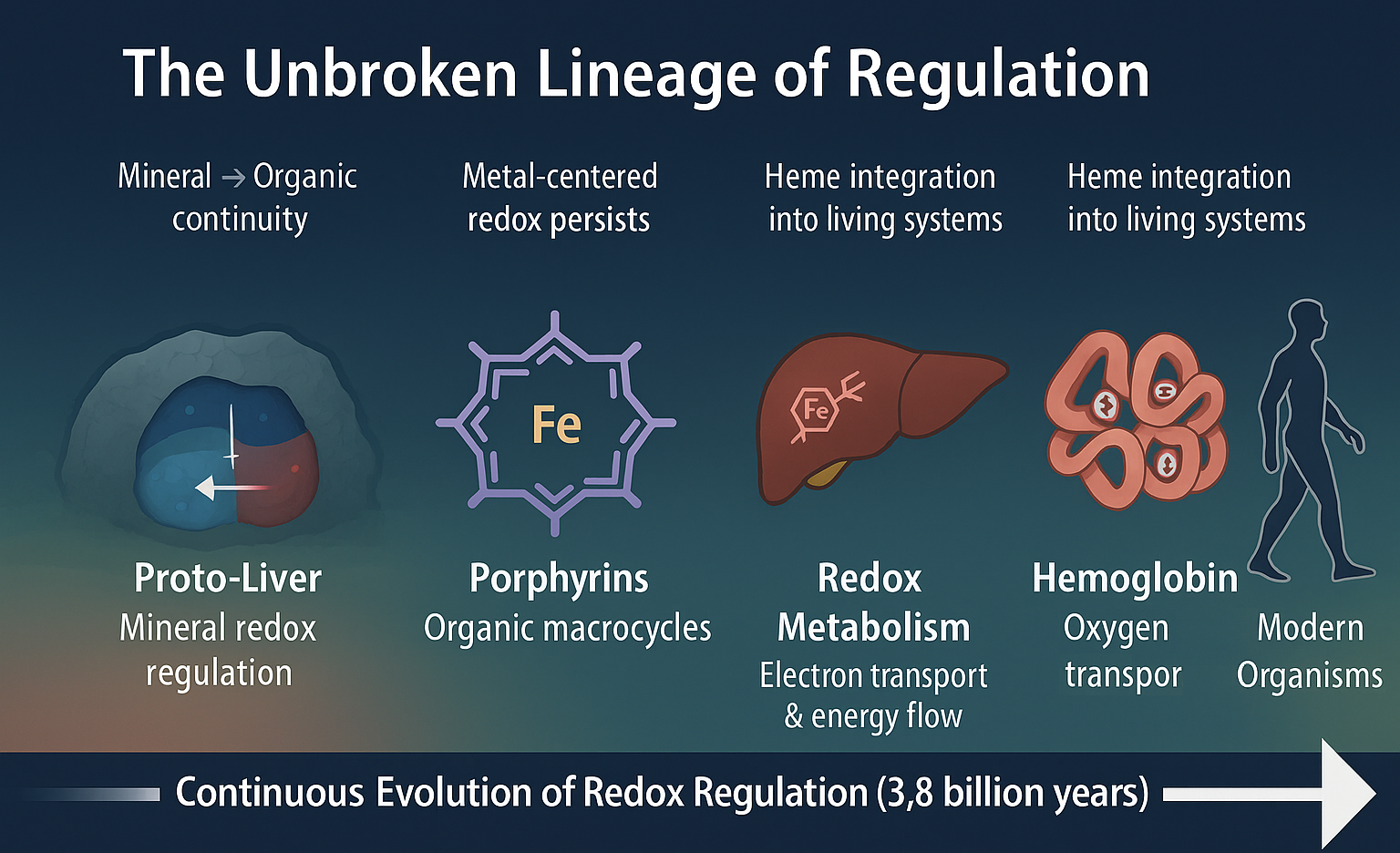
Shows how the proto-liver’s chemistry eventually flowed into porphyrins → heme → hemoglobin — a direct chemical lineage from ancient redox control to modern biology.
7. Regulator-First Framework (Large Paper)
A full scientific version tying everything together into a single model for the Origin of Life.
In Plain Terms
I started out wanting to understand why the liver is so smart.
By reverse-engineering it, I ended up finding:
a missing piece in the origin of life
a new explanation for metabolic evolution
a path for how redox chemistry became biology
a way to unify metabolism-first and regulation-first theories
a continuous line from mineral chemistry → proto-liver → early life → heme → modern organisms
It turns out the liver didn’t just save us.
A version of it — a “proto-liver” — may have been what allowed life to begin at all.
Contact us
Interested in working together? Fill out some info and we will be in touch shortly. We can’t wait to hear from you!